
From surviving to thriving: Making space for peace and love
Reflecting on 44 years of life, love and personal growth, and moving beyond struggle to welcome more peace, connection and possibility.
In this blog we will look at what a time out is, and why they aren’t good for your cat(s). Despite it becoming a popular way to discipline cats I’ll share with you below how it can actually damage your relationship with your feline friend.
Ok so buckle in peeps because I am not going to hold my tongue or be politically correct on this topic!
Cats are not children. It may seem OK for people to give children a ‘time out’ but cats are not kids. I don’t have an opinion or perspective on using the time out method on kids as I don’t have them so I can’t comment. What I do know is cats. What I do have is two sentient, sensitive beings that just happen to be in the body of a cat.
Cats I do. Kids, not for me.
What I found incredibly heartbreaking as I began to research for this blog (and actually had to stop because I started to cry reading about this topic), is that giving cats a time out is not only becoming popular but actually recommended by cat behaviour sites as a ‘good’ method of behaviour modification. WTAF!
‘It helps your cat to realise their behaviour is wrong’.
‘It helps your cat to know who’s in charge.’
‘It gives your cat time to think about what they’ve done.’
Seriously … those are all statements I found on (apparently) respected feline behaviourist sites. And no I won’t be sharing the links or sources as shaming others is not my brand.
A time out is when you shut your cat in another room after they have displayed a behaviour.
Apparently it goes: behaviour > ‘punishment’ > reduced/stopped behaviour.
I mean seriously …. People think this is the way to do behaviour modification with a cat??

You are in a room with someone who speaks a different language to you. You are trying to make a connection and understand each other. You act like you would, a behaviour or action that is you and then suddenly they get hold of you and shut you in a room. Would you understand what was going on? Would you be inclined to try and connect with that person again? Or would you be a little more cautious when you came into contact with them next time?
Using a time out with a cat is a lazy option. There I’ve said it. I did tell you at the start of this blog I wasn’t going to hold back or be politically correct.
Before the haters get on my case I’m talking about using a time out to punish ‘bad’ behaviour. As a qualified behaviourist I can tell you from years of experience not just with cats but also as a psychologist that positive reinforcement behaviour modification works much better than punishment when it comes to trying to make changes.
With cats they won’t sit in a room and think about what they’ve done. They will start to sniff around the room for familiar scent markers, they will try to adapt and feel safe in their new environment.
When you give your cat a time out because they displayed a behaviour you didn’t like you are only punishing yourself. The connection and relationship you have with your cat will be impacted.
I do understand that some cats can get over excited, that some cats can get over stimulated but shutting them away to punish a bad behaviour is a bad move.
Scratching furniture, climbing up onto worktops, climbing curtains, eating plants. These are all natural behaviours for cats. If you don’t like it then YOU are the one that needs a time out! Time to research WHY your cat is doing what its doing. Time to look at HOW you can support their need (i.e. for heights, or plant materials).
When it comes to cats displaying a behaviour you don’t want or like YOU have to do the work. Look at how else you can meet their need to climb, to eat essential nutrients etc. Step up.
Yes there can be a need to give cats calm time, to separate aggressive or attacking cats. One of the best ways to do this is to have a calm room set up. A room that has another litter tray, scratching post, cat bed, food/water sources.
Almost like a home away from home. A space the cat can feel safe in.
There are definite advantages to giving cats calm time, away from the kids or busy family. Away from other animals if they don’t get on. But the reason that you separate the cat from the family is for the benefit of the cat. Their health and well-being. To nurture and support them. Not as a punishment.
Punishment is one of the slowest methods to change behaviour. Love, nurture and support will change it much quicker than removing your cat from the situation to ‘think about what they’ve done’.
So if you are a cat guardian that uses a time out as a punishment, PLEASE take a moment.
Consider this – if you want to love and help your cat. Make time to understand them. Make time to change your house, the home and look at how you can support your cat rather than punishing it.
I hope this blog has given you food for thought.
Please share it with anyone you know who uses this cruel and pointless method of (unhelpful) behaviour modification.

Soul activator for cat guardians, empath, author and cat mum.
Helping anxious humans with anxious cats.
Giving cats a voice and changing the world's perception of cats.

And if you’d like to be part of a warm, spiritual community of cat lovers who cherish deep connections, spiritual support and gentle souls, join my FREE, online community: The Soul Space.
Reflecting on 44 years of life, love and personal growth, and moving beyond struggle to welcome more peace, connection and possibility.

After years of stress, grief and caring for our cats, joy can feel unfamiliar. Explore how to embrace happiness and feel safe experiencing it.
Learning to navigate change, embrace uncertainty and find acceptance when life doesn’t go as planned. A personal reflection on adjusting to life’s changes.
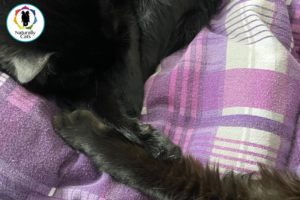
The story of Baby Max and his brother Leo, their unique bond, life together and how Baby Max is adjusting to the loss of his feline companion.

Before he transitioned, Leo shared powerful messages through animal communication. Discover his lessons on love, life, death and the spiritual bond we share with cats.
In this blog Julie-Anne shares the story of saying goodbye to her cat Leo. Sharing what led to his passing back over the rainbow bridge.